
A Fresh Look at Revelation 16:16 "And they assembled them at the place that in Hebrew is called Armageddon." (ESV) — Ἁρμαγεδών Harmagedōn.
In the first in this series on reading Revelation, The Revelation Reveals While It Conceals (click to read it), I looked at two examples of John's method: writing one letter for two audiences, with the Old Testament as the hidden reference key that unlocks what Roman censors would read but wouldn’t understand.
The "elect lady" of 2 John looked like harmless family correspondence to Rome—but ‘the church itself’ to anyone who knew the code. The 144,000 looked like a census to outsiders—but a precise statement about the full complement of God's people to insiders.
There's a third example, and most of us know it by its pop-culture name: Armageddon. In 1998, Bruce Willis starred in the Michael Bay movie of that title. But "Armageddon" is actually a mispronunciation of a Greek spelling of a Hebrew phrase—if you can get your head around that—and once you slow down and look at it, the popular reading falls apart fast.
Why This Matters
We live in a world flooded with sensational end-times speculation. We already know how the term "Apocalypse"—which means "Revelation", the title of John's letter—has been made to mean "World Ending Disaster". In the same way "Armageddon" has become shorthand for cataclysmic earthly warfare—complete with maps, timelines, and geopolitical predictions.
But what if John’s actual word in Revelation 16:16 points us somewhere far more profound: not to a valley battlefield in Israel on Earth, but to a place with far deeper spiritual and Earthly implications? Recovering this Old Testament-rooted meaning shifts our reading of Revelation from anxious newspaper exegesis—with meaning only for those in the 21st century, to those with confident confidence in God’s sovereign rule over all of history. It’s worth investigating because it restores the depth, beauty, and hope of John’s original message—one that first century believers grasped through Scripture, but that later generations have largely misplaced to their detriment.
A Mountain That Isn't There
Revelation 16:16 says the kings of the earth are gathered to a place "called in Hebrew, Har-Magedon." For many readers, this is finally a real place on Earth—something to put a pin in on a map. We're told it's Megiddo, a famous ancient site in northern Israel.
But here's the problem. "Har" means "mountain" in Hebrew. "Magedon" gets read as "Megiddo" mostly because the two words sound alike. So "Har-Magedon" supposedly means "Mount Megiddo."
There's a few issues with this, the most glaring is: there is no Mount Megiddo, and there never was.
Megiddo sits on the floor of the Jezreel Valley—one of the flattest, most open and fertile stretches of land in the whole region. That's exactly why it's famous: armies have gathered there for thousands of years because you can move chariots and troops across it without a hill in the way. What's actually at Megiddo is a tel—another Hebrew word. A tel is a mound made of the layered ruins of older cities. A mound on a plain is not a mountain. At the highest estimates Megiddo sits a mere 200 feet above the flat plain.
Megiddo is a mound, not a mountain by any standard.
So if you wanted a name for "the great open battlefield," Megiddo fits perfectly. But if you wanted a name for a mountain, Megiddo is the last place you'd pick.
Another Issue Hiding in the Spelling
There's a second problem, and it's easy to miss in English. Hebrew actually has two different letters that can both sound like "g"—somewhat like how the English letter "c" and “k" can both make the same sound—Greek, however, has only one “g” like English.
The "g" in Megiddo's name is one of those letters. But there's another Hebrew word—mo'ed, meaning "assembly" or "meeting"—that uses the other "g"-sounding letter. In English scholars differentiate the second Hebrew “g” with an apostrophe: ‘ . Which means "Magedon" could just as easily be read as mo'ed. Remember, the Hebrew that the Old Testament was written in had no vowels.
The double form of 'g' turns out to matter—because a plain reading revealed that mo'ed is exactly the word John seems to be referencing. He’s not pointing to Mount Megiddo—which doesn’t exist—he’s pointing to “the Mountain of Assembly”. Is there any Mountain of Assembly in the Old Testament? Oh yes, there is!
Opening the Dictionary
Isaiah 14 is a famous oracle against the king of Babylon, which turns into a rebuke of a much bigger, and more ancient, spiritual rebel against God. In the middle of it, the rebel is said to boast:
"I will sit on the mount of assembly (har mo'ed) in the far reaches of the north." (Isaiah 14:13).
Har mo'ed—"mountain of assembly." That's not just a similar phrase. It is the exact Hebrew word John is referencing, in Greek it's spelled the exact way John did in Revelation 16 "Har-Magedon".
So what does "the mountain of assembly" mean in the Old Testament? And why does he want to sit there? It means a lot, actually.
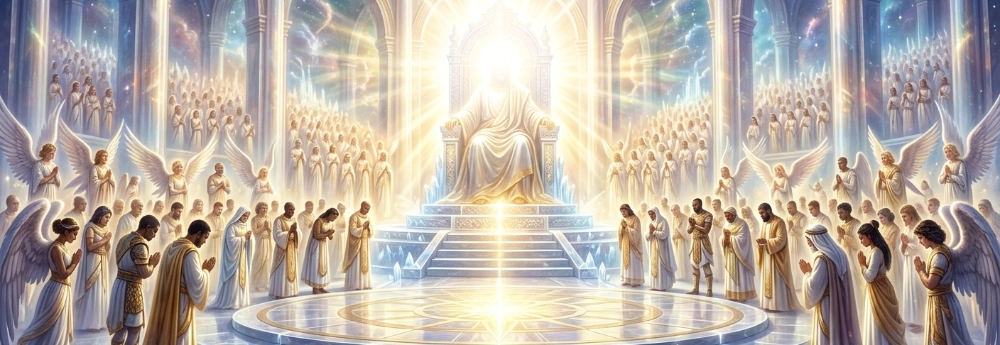
In the Bible imagery, “God's mountain" isn't first of all a single place on Earth—it's any number of locations intersecting the spiritual realm, the place where heaven and earth meet, or it's where God's Divine Council gathers and God hands down verdicts and gives or refuses permission. And it’s where God sits and everyone else stands, because sitting is the posture of authority. This rebel being in Isaiah 14 wants to sit and have God stand, he wants to rule over God on the Mountain of Assembly.
This is the same scene in Psalm 82, where God stands among the "gods" and judges them (going from sitting to standing is God pronouncing judgement, as James does in the Jerusalem council in Acts 15). It's also the same scene in Job 1, where the "sons of God" present themselves before the Lord. And again in Daniel 7 where The Ancient of Days takes His seat in a Divine Council location set up by the sea. Again we see it in 1 Kings 22 when Micaiah the prophet said, "I saw the LORD sitting on his throne, and all the host of heaven standing beside him on his right hand and on his left." Eden, Sinai, and Zion are all, in different ways, that same spiritual mountain of meeting—God's Divine Council.
I give all those examples because it's really important to note that the Mountain of Assembly is not an obscure Biblical reference, John likely picked Isaiah 14's reference because less Romans would have known it, but the concept was very well understood by Jews.
And there's also an Old Testament prophetic scene that maps almost perfectly onto the "war of the great day” two verses earlier in Revelation 16:14: It's Ezekiel 38–39, where Gog (the prince or ruler) and Magog (the land he rules) and a coalition of nations gather against Israel for a great battle—one that ends not with armies clashing, but with God's direct judgment.
Revelation 20 John calls on this same coalition again, the ruler and the land of Magog. But he's referencing it here again very subtly in Revelation 16:16 with the Mountain of Assembly. If we read the Isaiah 14 reference again carefully: "I will sit on the mount of assembly in the far reaches of the north." (Isaiah 14:13). What are the 'far reaches of the north,?
Magog appears as a grandson of Noah in Genesis 10:2, with his descendants he is understood to have settled to the far north of Israel, likely corresponding to Europe and northern Asia. From there, Magog functions in Ezekiel as a land in the far north from which a great end-times coalition will wage war against Israel. John picks up on Paul's reference to the Church as the 'Israel of God'—in Galatians 6:16 and other places—and co-opts Ezekiel's and Isaiah's imagery to point to the spiritual battle that has always been waged between God's people and God's enemies.
Psalm 2 puts the whole pattern into a single scene: the kings of the earth plot together against the Lord and his Anointed—and God simply laughs at them and their ancient rebel spiritual overlords.
All this subtlety of reference is absolutely necessary, the Roman eyes were looking for any sign of rebellion or militiary resistance against their rule, the Jewish people had, many times, mounted hard-fought military rebellions against Rome. To Rome Magog was ancient Jewish prophetic superstition, but with Ezekiel, Isaiah, and Paul's letters—especially to the Ephesians—John's readers had all the many keys they needed to unlock the meaning of the Mountain of Assembly and the far reaches of the north.
The writer of Psalm 121— a Psalm of ascents— starts off with a rhetorical question for a Jewish listener: “I lift up my eyes to the mountains (same har but plural), where does my help come from?” In our minds he would like us to play a little game, does help come from the mountains? Maybe there’s a big army coming down to aid us, or a river about to start flowing… He answers his own question in verse two “My help comes from the LORD, who made heaven and earth.” And we affirm, now in the major chord, no, not from the mountains, but from He who sits on the mountains in the assembly... not from the mountains but from the One who made them…
That response is built into a lifetime of study, prayer, and meditation of God’s Word to the Jewish people, the Old Testament. And that response is what John is relying very heavily on in the Revelation, make sure you build it Christian!
So when John writes “Har-Magedon”—and tells us it’s a Hebrew term—a reader who knows their Old Testament doesn't think, "which valley is that? What does it sound like?” John isn’t playing charades, he’s mapping precisely onto well worn, Old Testament concepts. Those familiar with them think: the mountain of assembly. The place where God’s Divine Council gathers and His verdict comes down on Magog and the ruler of the north.
One more tiny clue that has enormous end-times power. Since Elijah's threat of drought against Ahab's evil rule—and the consequent three and a half years of drought followed by Ahab's eventual downfall and the destruction and assimilation of Israel by Assyria. Any thing coming from the north—and anything to do with three and a half—was regarded as a very bad omen for the remaining Jews in Judah. That's a thread I'll pull on another day, but it is mixed into all of Revelation's dense symbolism.
Two Audiences, Once Again
Let's go over John's method again.
To Roman ears, "the mountain of the gods, where the powers gather for one last war against Magog and their ruler Gog" would sound very much like... Greek mythology—or Roman mythology… Gods squabbling and fighting on a sacred mountain was old news to anyone who knew the stories of Olympus. Harmless myth that doubtlessly caused any self-respecting Centurion to yawn the way he did when he was forced to learn them in Greek as a child.
But to a reader who knew Isaiah, Ezekiel, Paul, and the Psalms, "Har-Magedon" wasn't generic god-talk at all. It was a precise pointer back to the real Divine Council—the one Greek mythology had only ever borrowed and distorted. John's readers would have recognized exactly whose courtroom that was—and whose verdict was about to be read. It is the same structure Jews would think about when Jesus said: “Thy will be done on earth as it is in heaven.”
One phrase with two audiences and two intended readings.
When the Code Outlived Its Readers
Here's what makes this example different from the others. The "elect lady" and the 144,000 got decoded fairly early and the church never lost track of what they meant—until about 200 years ago in the case of the 144,000. Har-Magedon is the one place where the concealment may have worked a little too well. As the church drifted further from its Hebrew roots, the Divine Council background that made "mountain of assembly" obvious to Jewish Christians began to fade. Without the Old Testament association we tend to rely on whatever else is laying about—a Greek word, Megiddo, that sounded a little like a famous battlefield, for example.
So later Christian readers did exactly what John's original audience were never meant to do: they took spiritually symbolic language and went looking for it on a map of Israel. "Mount Megiddo" became a coordinate for a future war. The fact that there is no mountain at Megiddo—which should have been the giveaway—got explained away instead, because by then so few knew to reference the Old Testament as the code breaker for Revelation to begin with.
This, of course, is not because John failed or because God’s Word was too obscure, but because the Hebrew dictionary we’ve had from the get-go got put back on the shelf.
A Simple Rule
Here's the takeaway: when Revelation gives a name, don't just play charades "what does this sound like?" Ask what the name means in the Old Testament. If you're told to it’s a mountain then it obviously isn’t a plain, that's not a detail to explain away—it's the text waving its hand, pointing you back to the dictionary. There may be a bit more work to do, but it’s well worth doing!
 Brandocrasy