
How to Read the Bible's Most Misunderstood Book.
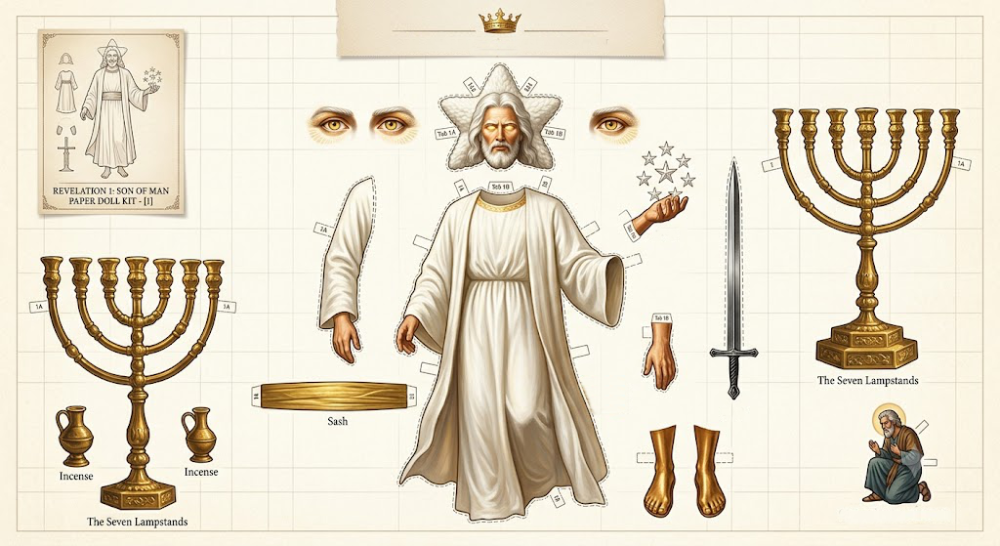
Here's a tool you can use to figure out what images in the Revelation mean in John's gospel and the book of Daniel:
jdr.mesotopia.net
A Letter With Two Audiences
Somewhere between 68 AD and 95 AD, a Jewish Christian apostle and pastor named John—one of Jesus’ original disciples—was writing letters from the island of Patmos—exiled there by Rome for refusing to stop talking about Jesus. His letters were going to churches scattered across what is now western Turkey. And Rome was watching. John’s letters were likely the last pieces of the Bible to be written, and that’s important because they reference the rest of the Bible; and none more so than his apocalyptic letter The Revelation.
The first thing we need to understand about Revelation: it was written under Roman surveillance. John couldn't write plainly about Roman oppression, imperial blasphemy, or the ultimate defeat of Caesar's empire without putting himself and his readers at serious risk. He needed to communicate clearly to his people while remaining opaque to his captors.
So he wrote in code. But not an invented code—an ancient one. One his readers already knew pretty much by heart. The Holy Spirit inspired a revelation which also conceals.
Why John Needed to Write Cryptically
John was likely writing either at the height of Nero’s persecution of Christians all through the empire, or about 30 years later. All of his compatriot apostles were executed, most in extremely cruel ways. Fox’s Book of Martyr’s tells us that the reason why John was exiled is that they tried to boil him and to stab him to death but God rescued him each time. Unable to kill him they did the next best thing, they exiled him. Rome didn't tolerate dissent quietly. Christians were being persecuted for refusing to declare Caesar as Lord and God—a political loyalty test dressed in religious language. Either way, the letters he was sending back to the churches were certainly intercepted by Roman rulers.
A letter that openly called Rome "the beast" or predicted the empire's collapse would be a death warrant—not just for John but for the communities receiving it. If John had blatantly said that Nero was in league with evil the whole community would have been at risk, so he cleverly disguises Nero’s name in 666 with Hebrew alphabet/number tradition called gematria—assigning numerical values to letters. "Nero Caesar" transliterated into Hebrew characters—Neron Qesar (נרון קסר)—yields exactly 666 when you sum the numerical values of the Hebrew letters. The Greek spelling of his name doesn't produce 666, but the Hebrew does. And very few Romans spoke Hebrew. Hebrew has the added advantage of inventing and perfecting apocalyptic literature. Daniel, Zechariah, and other similar texts are part of the Hebrew tradition, so when John’s Revelation comes along in the same lines it induces Roman head scratching and shoulder shrugging, but not suspicion.
John needed what we might today call plausible deniability. What he wrote had to be able to pass through Roman hands without triggering alarm, while simultaneously delivering its full, and intricately detailed, message to readers who had the key to decode it.
Hebrew symbology is also very selectively layered. When we imagine the woman in Song of Songs, we’re not invited to create a surrealist Marvel special effects conflation: A flock of goats for hair; doves for eyes; a mouth with sheep eyes; a neck made out of bricks. That would be a rather unpleasing montage. Metaphors, in the Hebrew tradition, are not primarily visual, they are meditative and symbolically layered… just like a dream. They aren't supposed to make sense as a whole, they are meant to be separated and each element pondered upon separately. We should think about what a woman with neck like a brick tower must be like, full of character and diligence, honorable, head held high. We should imagine that dove-like eyes are shy, easily startled, pure, innocent, beautiful. A flock of dark goats flows down a mountainside with life and bounce and vigor, like her hair. Special effects have played havoc on the collective Western imagination, reducing it's range to a very bland literalism.
This is why Revelation feels so strange to modern readers. We're trying to read a coded letter without referencing the code—or even knowing that we should—and we’re trying to imagine a comprehensive image instead of meditating on each aspect independently. We have—I’m sorry to say—a very underdeveloped imagination. We see bizarre creatures, impossible numbers—too large, too small, and surreal imagery and assume the book is either hopelessly obscure or meant to predict news headlines and specific nations two thousand years later (which would have rendered them useless to their original audience). Both readings miss the point entirely.
The Codebook Was Already Written
Here is the central insight that unlocks Revelation: John didn't invent his symbols. He inherited them and put them to good use.
The entire symbolic vocabulary of Revelation—its numbers, creatures, colors, actions, and images—is drawn from the Old Testament. In fact, as my friend Ian McKellar says, “the Old Testament is the dictionary for the New Testament.” John was a Jewish scholar steeped in the Hebrew scriptures from childhood. When he writes about a lamb, a dragon, a woman clothed with the sun, a city with twelve gates, or an army of 144,000—he is not being creative, he is being referential. Every image has an address somewhere in the Hebrew Bible, often at multiple places.
This is what makes Revelation simultaneously encrypted and transparent. To a Roman official reading over a courier's shoulder, it looked like exotic religious poetry—strange but harmless. To a Jewish Christian reader in Ephesus or Smyrna who had grown up hearing Isaiah, Ezekiel, Daniel, and the Psalms, it was anything but obscure. It was a map drawn in a language they already spoke. The majority gentile believers in Asia Minor had the Jewish believers on hand—many had been kicked out of Rome and many others had left Jerusalem as conflict brewed—to help with the symbolic interpretation.
Ian’s statement is spot on: the Old Testament is a dictionary for the New. Nowhere is this more true than in Revelation. John is writing in Old Testament language. The whole symbolic vocabulary is simply assumed, it’s not explained, because explanation would defeat the purpose.
Two Examples: Watching the Code Work
The best way to understand this is to watch it in operation. Here are two examples—one from Revelation itself, one from a companion letter John wrote around the same time.
The Dear Lady
John's second epistle (we call it 2 John) opens with a greeting to "the elect lady and her children." For a Roman official reading intercepted mail, this is entirely unremarkable—a letter to a respected woman and her household. Likely Mary, the mother of Jesus, whom John had been designated to care for at the crucifixion. It’s family stuff, nothing suspicious here.
But John's readers knew exactly what he meant. The "elect lady" is the church—the bride of Christ. Her "children" are the congregation. John is writing an ecclesial letter about doctrine, love, and warning against false teachers, dressed in the language of a domestic correspondence. The Romans see family mail. The church reads theology.
This is John's method throughout. Two audiences, one text, two entirely different readings—to one the message is concealed, to the other it’s a revelation.
The 144,000
In Revelation 7, John describes a group of 144,000 people who are sealed and protected—drawn from twelve tribes of Israel, twelve thousand from each tribe. To a Roman reader this looks like a census of ancient Jewish families. Nothing threatening there, the number isn’t particularly large and 10 of those tribes had no longer existed for close to 800 years. It must therefore be a wishful dream of ancient Jewish history.
But to a reader with the Old Testament dictionary open, the number is doing something far more sophisticated. Twelve is the number of God's covenant people—twelve tribes of Israel in the Old Testament, twelve apostles in the New. Multiply twelve by twelve and you get 144, the number of completeness—particularly the completeness of God's people—squared. Multiply that by 1,000—the biblical number of vastness and totality—and you get 144,000: not a literal headcount but a symbolic statement. The complete and total people of God, from both testaments, fully accounted for.
The mathematics are confirmed by the architecture. Ezekiel's prophetic temple—which symbolically describes the church—has walls 144 cubits thick and dimensions of 12,000 stadia. The New Jerusalem in Revelation 21 is built to the same measurements, now cubed. John is using the same numbers Ezekiel used, drawing from the same dictionary, encoding the same truth: God's people are complete, whole, and fully secured.
Then John turns and sees the great multitude—too vast to count, drawn from every nation, tribe, people, and tongue. It’s the same group, through a different lens. The 144,000 views them through the covenant lens: structured, counted, architecturally complete. The great multitude views them through the scope lens of the New Covenant: the Babel scattering fully reversed, every nation now standing directly before the Lamb, the “Israel of God” in Galatians 6:16. Or we could use Jesus’ word in Matthew 16 and 18 for these two groups: the Church. Two images—144,000 and a Great Multitude, two facets of one reality, zero confusion—if you have the dictionary.
Learning to Read What John Wrote
Once you understand these two principles—John's need for cryptic discretion, and the Old Testament as his cipher—Revelation stops being a puzzle and starts being a delightful and meaningful portrait. The strange becomes familiar, the obscure becomes precise. But for us in 2026 it takes a bit of work. Not nearly as much as you imagine because the heavy lifting has already been done for us. We have access to copious Biblical hyperlink reference tools.
The book was never meant to be a secret to Christians. It was written to reveal—the very meaning of the Greek word apokalypsis is an uncovering, a pulling back of the veil, not a concealing. The encryption wasn't designed to hide truth from believers but to hide truth from empire. John's first readers didn't find Revelation confusing, they found it clarifying, comforting, and electrifying—because they had the dictionary.
The good news is that the dictionary is still available. It's the same Bible John grew up reading. Learn to read the Old Testament as the vocabulary of the New, and you'll find that Revelation—the most misunderstood book in the Bible—turns out to be one of the most precisely written in stunning symbolic detail.
Two rules I follow when reading John’s Revelation:
- Each image is symbolic and trails off into the literal, one thing an image cannot mean is its literal meaning. Symbols are chosen precisely because they point beyond themselves; the moment you literalize them you've stopped reading symbolically and started reading a different kind of text entirely.
- There is no mention of Russia, the USA, modern Europe or any modern, secular nation in Revelation—indeed in the Bible. Both of those traditions—of literalizing apocalypse and reading modern events into the Bible—comes to us from one man, who had no understanding of either Greek or Hebrew, about 200 years ago. We should abandon that tradition absolutely.
The Revelation was a revelation all along, while it was also a brilliant bit of concealing.
Here's a tool you can use to figure out what images in the Revelation mean in John's gospel and the book of Daniel:
jdr.mesotopia.net
 Brandocrasy