
How the Revelation points to Jesus through a name and a book.
In the first two pieces in this Reading Revelation series, I showed you two ways John hides things in plain sight—the "elect lady" who's really the church, and "Har-Magedon" which isn't Mount Megiddo at all, but a mountain that is not really on earth at all. John, you see, was writing for two audiences at once: he knew the Romans would read one layer, the church in Asia Minor would read an entirely different layer because they had the key, the rest of Scripture.
This time I want to show you a third example of that same method, the name Joshua, and how it functions in the occupation of the Promised Land, in Zechariah's post-exile prophecy, and how John uses it to reference Jesus himself.
A Priest Named "God Saves"
In Zechariah 3—post exile Judah and the rebuilding of the temple—the prophet is given a vision: Joshua the high priest at the time (not to be confused with Joshua the leader into the Promised Land after Moses) is standing before the angel of the LORD in God's Divine Council—the Har-Magedon of Revelation 16:16—and right next to him is the satan—literally, in Hebrew, "the accuser", not a proper noun—standing there and bringing charges against Joshua. Joshua is dressed in filthy robes, which indicate his culpability. They are not stained, they are filthy. The kind of clothes you'd be embarrassed to be caught in, let alone stand before God and his heavenly host in!
Joshua isn't just having a bad day in Zechariah's vision, this isn't self-help, Old Testament style. As High Priest Joshua is representing (standing in for) the whole nation of Judah, a people just back from seventy years of exile, still covered in the guilt, the mess and disgrace of everything that got them dragged off in the first place. This accuser has a legitimate case.
And then God steps up in the form of the "Angel of the LORD". He rebukes the accuser indirectly: "The LORD rebuke you, oh accuser," and He defines this man as a "stick rescued from the fire." Then He says, "Remove the filthy garments." Joshua is stripped naked and then re-dressed in clean clothes restoring human dignity and a clean turban restoring human authority. And then this angel of the LORD adds a few more things: "I will bring my servant the Branch." A stone is set in front of Joshua, and God says that He will "remove the iniquity of this land in a single day." He then makes a promise to Joshua that, should he continue in obedience and submission, that God would give him, and those he represents, a standing place in this very council he was dragged before in filthy rags.
This priest—right at the climactic conclusion to the whole Old Testament narrative is: cleared of an accusation neither he nor his representatives could answer for, pointed forward to someone else entirely, and given covenantal promises of future promotion. I'm hoping this sounds familiar to you.
The Name Is the Point
You see "Joshua" and "Jesus" are the one and the same name. Joshuah is the Anglicized form of the Hebrew version, and Jesus the Anglicized form of the Greek version, of the same name.
In Hebrew, Joshua is Yehoshua—"the LORD saves." In the Greek New Testament, that same name is spelled Iēsous which is rendered Jesus in our Bibles. Same name, same meaning. This isn't a coincidence anybody that John was addressing in the Revelation would have missed. The writer of Hebrews plays on it directly: "If Joshua had given them rest, God would not have spoken later about another day" (Hebrews 4:8). He's making a pun that only works because both men, Joshua—who lead Israel into he Promised Land—and Jesus carry the same name, and only one of them actually delivered what the name promises.
So when Zechariah puts a man named Joshua at the center of a scene about accusation, cleansing, rescue, and a coming "Branch" who will build God's temple and sit as "priest on his throne" (Zechariah 6:13)—a king and a priest in the same person He's writing a preview of the coming Joshua, Jesus Christ. Zechariah's Joshua is a small, temporary, version of a much bigger Joshua still to come. He is a priest/king who prophetically represents the coming Lamb/Lion.
John, writing Revelation five hundred years later, picks up every detail of that preview: the accuser thrown down for good (Revelation 12:10), the clean white robes given to the redeemed (Revelation 19:8), a Lamb who is somehow both king and priest, holding both offices without any of the tension that would have broken any ordinary Israelite king or priest who tried it. It's a perfect opportunity to reference Jesus—whom Rome crucified—to John's intended audience in a way they couldn't miss it, without alerting Rome to the reference.
At the end of this article is a key that logs every reference John makes in the Revelation to the prophecy of Zechariah. These keys would have been accessed by John's audience but not by his Roman censors. Click here to read.
That's layer one; but there is a second layer that most people miss completely.
The Book, Not Just the Man
Zechariah, of course, didn't invent the name Joshua. He borrowed it. The first Joshua was Moses' successor, the one who organized and led Israel into the promised land. His name was already a household name eight hundred years before Zechariah's priest—also named Joshua—showed up.
The book of Joshua is a campaign of occupation. City after city, wall after wall, land divided up and handed out to twelve tribes in careful, organized detail. It is the most aggressive book in the Old Testament—it's not defense, it's offense. Israel doesn't wait to be attacked. They advance.
John's Revelation picks Joshua's structure for his Revelation.
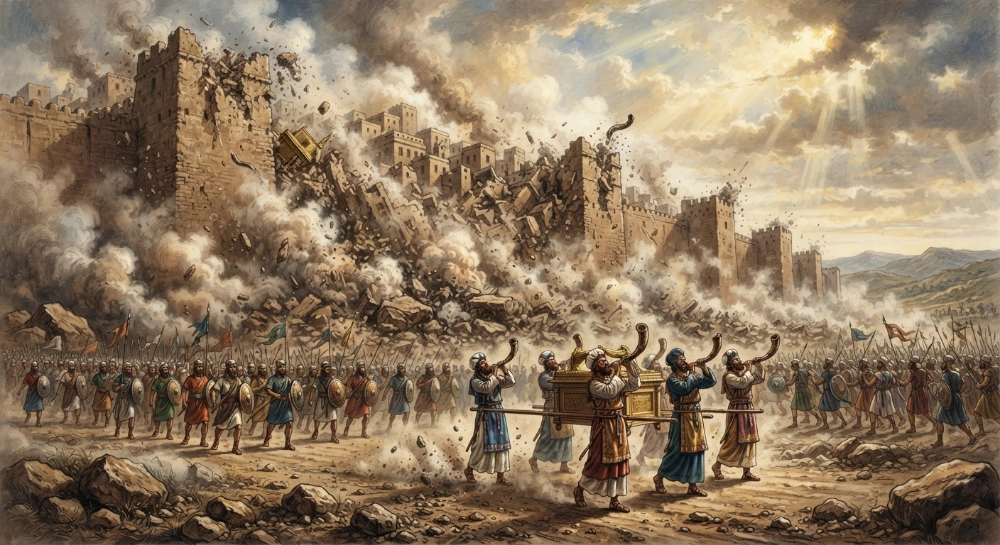
- Jericho falls in Joshua 6 through seven priests, blowing seven trumpets, marching for seven days, until the walls come down on day seven. Revelation has seven trumpets too (Revelation 8–11), and what falls at the end of that sequence is a fortified, guilty city. That's not a coincidence, it's a pattern lifted straight from the Jericho narrative in Joshua.
- Before the walls fall, though, Joshua has an encounter that sets the whole campaign in motion. A man appears to him with a drawn sword, identifies himself as "commander of the army of the LORD," and Joshua falls facedown (Joshua 5:13–15). Now go to Revelation 1. John sees someone with a drawn sword coming from his mouth, and John falls down "as though dead" (Revelation 1:16–17). Same posture, same kind of figure, same kind of moment—a commissioning before the campaign begins.
- And when the campaign is over? Joshua doesn't just win the war. He distributes the land—twelve tribes, twelve carefully measured inheritances (Joshua 13–21). Revelation ends with a city that has twelve gates named for twelve tribes and twelve foundations named for twelve apostles, measured out with a rod (Revelation 21:12–17). The conquest ends the same way both times: not just victory, but an inheritance, handed out and made permanent.
These are far more than coincidental curiosities, they are intentional references to details only Old Testament familiars will notice, and they are all built profoundly on one name: Joshua, Jesus Christ.
"The Gates of Hell Will Not Prevail"
Jesus' own words in Matthew 16:18 are also not defensive but more of a battle plan: “I will build my church, and the gates of hell shall not prevail against it.” There are many layers to these words. The fact that they were said on Mt Hermon, right by a place called the Gates of Hell where demon gods were said to descend. The fact that Jesus said them of Peter's divine inspiration from God the Father. The fact that the Church is the script revealing God's manifold wisdom to the Principalities and Powers. But for now let's just focus on one other fact: gates don't advance or attack. Gates are what a city hides behind when it's under siege. When Jesus says the gates of hell won't prevail against the church, he isn't promising that the church will survive an assault. He's saying the church is the one doing the assaulting—advancing on enemy territory. Just as the first Joshua advanced on Jericho, the way the true Joshua advances through Revelation's own trumpets and armies and open gates of a city built without any need for walls at all against its enemies, because there won't be any enemies left standing.
When we put the two layers together we get something remarkable. The name is the key that tells you who is doing this—the true "God saves," of whom every priest and every general named Joshua was only ever a preview. The Revelation tells you how he does it—not by hiding, not by waiting, but by organized, patient, unstoppable occupation of territory that used to belong to someone else.
Why This Matters
If you've ever read Revelation and felt like it was mostly a book about surviving—hanging on, white-knuckle enduring, waiting it out until the end hoping to not be 'left behind'—I'm hoping that this article shifts your view, the way it would have for John's audience under the thumb of Rome. Revelation is not a book about a church playing defense until reinforcements arrive. It's a book about the King-Priest—the Lamb-Lion—named Jesus, Joshua, finishing a conquest that started with another man of the same name, in another book, a long time before John picked up a pen on Patmos.
It is Him who says, “behold, I am coming soon. Blessed is the one who keeps the words of the prophecy of this book.” (Revelation 22:7).
Reference
Here are all the references to Zechariah's prophecy in John's Revelation:
Zechariah 1–2 (horsemen, measuring)
- Rev 6:1–8 – four horsemen (Zech 1:8–11; 6:1–8, the four chariots/four spirits of heaven patrolling the earth)
- Rev 11:1–2 – measuring the temple (Zech 2:1–5, the man with the measuring line)
Zechariah 3 (Joshua the high priest)
- Rev 12:10 – "the accuser of our brothers" (Zech 3:1, Satan standing to accuse Joshua)
- Rev 19:8, 22:14 – clean/white garments given (Zech 3:3–5, filthy garments exchanged for clean ones)
Zechariah 4 (lampstands, two witnesses)
- Rev 1:12, 20 – seven golden lampstands (Zech 4:2, the golden lampstand with seven lamps)
- Rev 11:3–4 – the two witnesses explicitly called "the two olive trees and the two lampstands" (Zech 4:3, 11–14, Joshua and Zerubbabel as the "two anointed ones")
- Rev 5:6 – the Lamb's seven eyes/seven spirits (Zech 4:10, "the eyes of the LORD which range through the whole earth")
Zechariah 6 (chariots, the Branch)
- Rev 6:1–8 – four chariots with different-colored horses (Zech 6:1–8)
- Rev 3:12 – the Branch who builds the temple (Zech 6:12–13, "Branch" who builds the temple of the LORD and rules as priest-king)
Zechariah 9 (the coming king)
- Rev 19:11 – rider on a white horse (loosely echoes Zech 9:9's king coming, though the direct image is different)
Zechariah 12 (mourning, piercing)
- Rev 1:7 – "every eye will see him, even those who pierced him... and all the tribes of the earth will wail" — a near-direct quotation of Zech 12:10, 14 combined with Dan 7:13
- Rev 1:7 – "tribes of the earth mourn" (Zech 12:12, "the land shall mourn, each clan by itself")
Zechariah 13
- Rev 13:8, 21:27 – book of life / those not written in it (loosely parallels the remnant motif of Zech 13:8–9, though the "book of life" image itself is more Exodus/Daniel-rooted)
- Rev 1:5, 7:14 – washing/cleansing by blood (Zech 13:1, "a fountain opened... to cleanse from sin")
Zechariah 14 (the Day of the LORD, final battle, new Jerusalem)
- Rev 16:14, 19:19, 20:8 – gathering of nations for battle (Zech 14:2–3)
- Rev 14:20, 19:15 – imagery of judgment "up to the horses' bridles" / treading (echoes the carnage of Zech 14:12–13, though Rev's winepress image draws more directly from Isa 63)
- Rev 21:23–25, 22:5 – "there will be no night," continuous day, no need of sun (Zech 14:6–7, "there shall be continuous day... not day and not night... at evening time there shall be light")
- Rev 21:24–26 – nations bringing their glory into the city (Zech 14:16–19, nations going up to worship the King)
- Rev 22:3 – no longer any curse (Zech 14:11, "there shall never again be a decree of utter destruction")
- Rev 21:15–17 – measuring the city (Zech 2:1–2 and 14:10 both involve dimensional/topographical description of restored Jerusalem)
- Rev 6:12, 8:12 – cosmic light-darkening at judgment (general Day-of-the-LORD language shared with Zech 14:6, though this pattern is broader OT — also Joel 2, Isa 13)
A few of these (the horsemen, the two witnesses, "every eye will see him") are about as close to verbatim allusion as John gets anywhere in Revelation—Zechariah is arguably second only to Daniel and Ezekiel as a structural source for the book.
 Brandocrasy