
Why “just believe harder” doesn’t work.
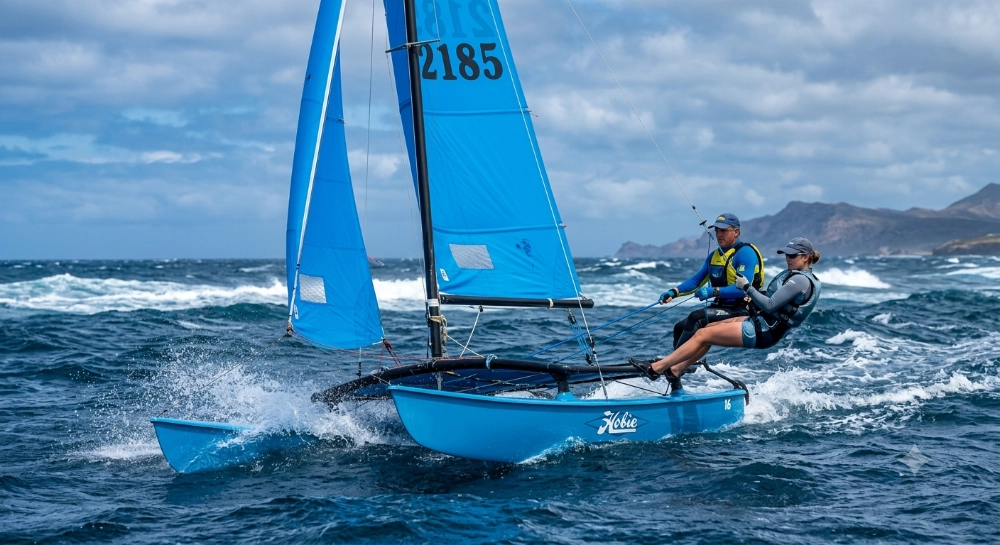
My dad and I used to sail our 16 foot Hobie catamaran, it was an exhilarating activity. The closer we sailed to the wind the faster we went, and the greater the chance of being blown over. Think about that for a moment, a sailboat tacks against the wind. It can, of course, sail with the wind. But it is engineered to sail faster against the wind. Sailing holds two opposing vectors in productive tension, and the resistance at speed is what makes progress possible, and actually a lot faster than merely being pushed along with the wind.
There was a man in Mark 9 who brought his suffering son to Jesus for healing. Jesus told him that all things are possible to him who believes. The man then said something that sounds like a contradiction: "I do believe. Help my unbelief.” He was not being incoherent, he was being honest. His belief was very real, so was his unbelief. And he brought both to Jesus rather than waiting until his belief was of a sufficient—though unspecified—quantity. Which is itself faith—the act of coming with everything he has, including the doubt.
The man's belief and unbelief are not cancelling each other out. They are both part of the same forward motion faith that pulls toward Jesus.
The sail always has both forces working on it. Faith is not the absence of doubt, it is the direction you are facing despite it.
In 2 Timothy 1:12 Paul asserted something that doesn't get nearly the attention it deserves. Facing execution, stripped of almost everything, Paul writes: "I know whom I have believed." Not “I know how much I have believed.” Not how well I have believed. Not how consistently or how confidently I have believed.
The overriding object of faith is in whom it is in. Faith is not primarily a human endeavor.
That single word—Whom—quietly dismantles a most exhausting misunderstanding in the Christian life.
Faith Is Not a Force, Luke
We have inherited, mostly without noticing, a picture of faith as something like interior voltage. Believe hard enough and things happen. Feel certain enough and mountains move. Generate sufficient spiritual confidence and the promises of God become accessible.
When Jesus said that faith the size of a mustard seed could move mountains, He was not telegraphing that faith that gets things done is about size. That reading turns His words into a self-improvement program.
He was teaching something far more radical: that, when it comes to faith, size is irrelevant. A mustard seed doesn't move mountains by its quantity, it moves them by being connected to the Mountain Mover.
We think that if we just have more… a kernel of wheat perhaps, or maybe an acorn… some have what seems to us to be a pinecone of faith. Jesus used the mustard seed to highlight that it’s not about the quantity of the faith, it’s all about in whom the faith is placed. The point is not the dimension of the faith, the point is the object.
My pastor, when I was a young man, used to tell this story of a mouse and an elephant walking together on a swing bridge. This bridge was swinging! As the mouse ran up and down the ropes he said to the elephant, “look at how we’re making this bridge swing!” Although the mouse had very little to do with the swinging of the bridge, he allies his insignificant actions to those of the elephant; and that is all that’s required.
We make faith a kind of work—and the most merciless kind, because it is unverifiable from the inside, and to an unspecified sufficiency. How do you know when you have believed enough? You don't. So you try harder, feel worse about your doubting, and conclude that the reason the mountain didn't move is that your faith was just not big enough. And God is wagging a finger saying, “tut tut tut, what a shame you don’t believe as much as you should,” like all those Santa movies.
This is not Christianity. It is far closer to George Lucas’ Force—a field of power that, in the Star Wars universe, responds to interior attunement. Feel it, Luke. Let it flow through you. Like Yoda’s criticism of Luke’s inability to ‘Force’ his X-wing fighter out of the swamp, we are inclined to focus invariably on our perception of the lack of faith quantity we have.
Jesus had something utterly different in mind.
Faith is not the absence of doubt, it is the direction you are facing despite it.
What Jesus Said in John 8
"You shall know the truth, and the truth shall set you free.” (John 8:32)
This is where it gets really interesting. We tend to read Jesus’ words through an Enlightenment lens: acquire correct information, and it will liberate you. We project that onto faith: believe the right things hard enough, and freedom follows.
But the Greek word for know here is ginōskō. It is not gnōsis—the Gnostic word for secret knowledge acquired. Ginōskō is a verb that lives in relationship and time. It is the word used for a husband knowing his wife, a woman knowing her baby, for God knowing Israel by name. It carries the full weight of the Hebrew yada—covenantal, intimate, progressively deepening. It is relational knowledge that involves as much heart as it does head.
The previous verse Jesus qualified, “If you abide in my word, you are truly my disciples,” and four verses later, "If the Son sets you free, you shall be free indeed."
The Truth that liberates has a face. The knowing is relational because the Known is personal. Jesus doesn't point to the door, He is the door.
Which means the freedom of John 8:32 is not the result of believing hard enough with a head-knowledge, academic kind of discipline. It is the result of being in direct contact with the Person who actually liberates.
Our relationship with Jesus is obviously crucial, but the relationship doesn't set us free, He does.
He Doesn't Build You a Refuge. He Is One.
Psalm 46 opens with a statement that has no human subject doing the load-bearing work: "God is our refuge and strength, a very present help in trouble."
Not: God will build us a refuge if we trust Him sufficiently. Not: God becomes our refuge when our faith is strong enough to access Him.
God is our refuge. Present tense, no conditions attached.
This is the pastoral enormity of it. The person whose faith feels thin, whose prayers feel like talking to a ceiling, whose doubts outnumber their certainties—they are not less refuged. The ontology doesn't flicker with the feeling. He is your refuge whether or not you feel His safety. It’s not the size of the faith, it just has to be in the Faithful One.
He is your refuge whether or not you feel His safety.
Faith Is Ontology, Not Phenomenon
Phenomenon is the perceptible experience, isolated from analysis and from originator—it’s not the sense of another’s nearness, but the nearness itself. Phenomena fluctuate. They depend entirely on what actually happens, before we’ve even filtered it through our senses, worldview, mindset, tiredness, emotions, chemical imbalance and a myriad of other human things. Long dark nights, filled with self-reproach and spiritual accusation come to every serious believer. Those are two separate things: the long dark nights (phenomena) and the filters by which we understand them.
Ontology is the fact and the state of being. You are either in Christ or you are not. The bridge either holds or it doesn't—independent of whether you feel terrified, or whether a different bridge gave way somewhere in your past.
Making faith primarily about the phenomenon hands the controls of your nervous system to circumstance. Every fluctuation in feeling becomes evidence of the state of your soul. It is an exhausting and ultimately self-defeating way to live; a loop that keeps turning the spotlight back on your own interior performance.
But if faith is ontological—a location rather than a feeling, a position rather than a performance, a fact rather than a happening—then assurance is not found by inspecting your faith. It is found by inspecting the Object of your faith. If we make faith phenomenological we end up trying to have faith in our faith. If we resist that temptation and make our faith ontological, then it no longer rests—in our thinking—on how much we believe, but in whom is this belief resting.
Like the boy who brought the loaves and fish to Jesus wasn’t trying to calculate cost, he simply said, “this is what I was given, you look like someone who can do something miraculous with it.”
Assurance is not found by inspecting your faith. It is found by inspecting the Object of your faith.
The Compass Doesn't Need to Be Confident in Itself
A compass doesn't need to feel certain. It doesn't need to believe in its own accuracy. It just needs a whole-earth magnetic field.
Faith should be confident—robustly, even joyfully confident. But the confidence is in the Object of the faith, not generated from within the Subject. It is inexhaustible certainty, imputed to us by the One who cannot fail. Which means the most confident faith is paradoxically the smallest, in a sense—the most self-emptied—the least reliant on its own interior sense of solidity—the most anchored in the reliability of Another.
I know whom I have trusted. It’s not the bullishness of Paul’s trust, it’s the Whom He trusted.
Paul wrote those words in a Roman prison, facing death, at the end of a life that had included shipwrecks, beatings, betrayals, and a thorn in the flesh that God declined to remove. His phenomenology had been through the mill of a persecuted life, but his ontology was unshakable. Because the One in whom he had believed could not be shaken.
That is the faith that endures; the faith that knows Whom.
So, set sail—whether in confidence or in doubt—only be sure that it is in faithful obedience to Jesus Christ.
 Brandocrasy